


Introduction
You just stepped out of a shower you were genuinely excited about. You used a new conditioner, that you were so excited about but as your hair air-dries, that familiar dread sinks in: it feels coarse, looks dull, and has all the vitality of packing straw.
It’s a specific, infuriating betrayal when a premium product delivers bargain-bin results. The problem isn't that you need an even pricier bottle; the truth is your hair is fighting a mechanical and chemical battle that luxury marketing completely ignores. When dry hair lacks enough moisture and oil to maintain its normal sheen and texture, the solution lies buried in your water quality, the ingredient list on that sleek bottle, and your application technique, not the price tag.
Key Takeaways
The fix for dry, lifeless hair often requires doing less to it, not spending more on it. Here's why your current approach may be backfiring:
-
Ingredient saboteurs: Heavy silicones and waxes in luxury conditioners often seal the hair so completely that moisture can't penetrate, creating a dry wasteland underneath.
-
The hard water trap: Mineral deposits from US tap water bond to conditioner ingredients, forming a dulling, water-repelling film that no amount of product can dissolve until you chelate.
-
Scalp application is a myth: You should be focusing conditioner exclusively on your mid-lengths and ends; massaging it into the scalp causes buildup and greasy, dehydrated roots.
-
Porosity is everything: Low-porosity hair resists absorbing conditioner (it just sits on top), while high-porosity hair loses moisture as fast as it gains it, requiring totally different formulas.
-
Protein vs. moisture confusion: Brittle, snapping hair might not be dry at all; overdosing on protein stiffens the shaft, and treating that with more protein-heavy conditioners makes it snap like a twig.
-
Internal ignition: An underactive thyroid or a nutritional gap can alter your natural sebum at the follicle level, producing dry hair that no topical conditioner can override.
The Structural Science Behind Straw-Like Hair
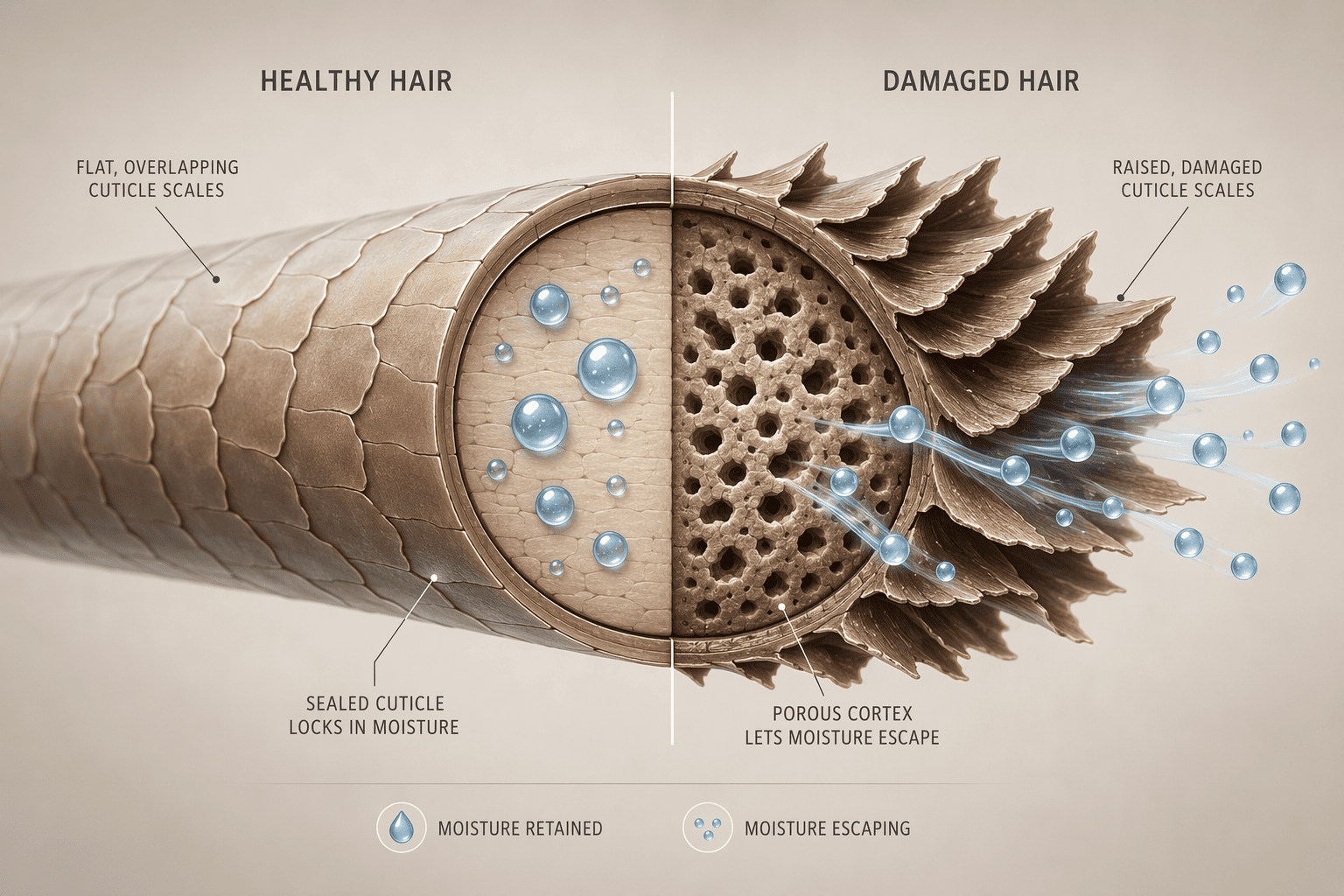
To understand why your hair rejects moisture, you have to look at the armor. The hair fiber's outermost layer, the cuticle, is composed of overlapping scales that protect the underlying cortex. In healthy hair, these transparent scales lie flat, creating a smooth surface that reflects light and seals internal water inside. When your hair feels silky, you’re literally feeling frictionless alignment.
Thermal tools, harsh brushing, and chemical dye strip away this defense. Damage to the cuticle, such as lifting or erosion of the scales, leads to increased porosity and a rough, dry feel. Once a scale is chipped, it’s permanent; hair has no living repair mechanism. The exposed cortex underneath hemorrhages moisture, leaving you with a texture that catches on collars and knots instantly.
Your conditioner is designed to fix this physical gap. Conditioners primarily work by depositing cationic surfactants, polymers, and oils onto the hair surface to smooth the cuticle and reduce friction. But notice that word: surface. If a barrier of mineral buildup or silicone is already coating your strands, those softening molecules simply float on top, unable to reach the raised cuticles to glue them back down. The expensive conditioner is the right chemical delivering its payload to the wrong address because the door is blocked.
When Luxury Conditioners Backfire: Ingredients That Worsen Dryness
Many high-end bottles feel decadent because they’re loaded with heavy, film-forming ingredients that create an illusion of softness instantly. The catch is that these films can calcify. Non-water-soluble silicones, like dimethicone, layer on top of each other with every wash. If you aren’t using a clarifying sulfate periodically, that shell repels the very water your hair needs to hydrate, creating a sealed-off, arid cortex beneath the shiny gloss. It’s a starvation cycle that feels soft to the touch but eventually flakes and cracks.
Then there’s the protein paradox. Brands market
The Hard Water Effect: Why Your US Location Is Sabotaging Your Conditioner
Your shower water might be the single biggest reason expensive conditioners leave your hair feeling like straw. Approximately 85% of US homes have hard water, meaning it's loaded with dissolved minerals like calcium and magnesium. Every time you rinse, those minerals deposit a microscopic film onto your hair shaft.
That buildup physically coats the cuticle, blocking the moisturizing ingredients in your conditioner from ever actually reaching the fiber. You end up conditioning the mineral shell instead of your hair. You might notice you need heaps more product to get any slip, yet the result is hard-watered hair and skin can be dryer, coarser and duller.
The fix does not require trashing your expensive products. A clarifying shampoo works by chelating those metals, dissolving the stubborn film that regular shampoos leave behind. Swapping to a clarifying shampoo every 7 to 14 days acts as a reset button for your hair. A chelating pre-wash, like the one in Kiwabi's Scalp Care line that pairs with their Natural Hair Care Products for All Hair Types, can intercept the minerals before you shampoo, restoring that vital access point for moisture.
How Incorrect Application Creates a Hydrophobic Nightmare
A conditioner’s job is to deposit a thin, even layer of fatty alcohols and cationic surfactants to smooth the cuticle. But if you apply a heavy conditioner to soaking-wet hair, physics works against you: water fills the hair’s porosity gaps, and oil and water simply do not mix. The conditioner beads up and slides right off. This is why a pricey mask can feel like it vanishes the moment it hits your head, a problem many people misdiagnose as a useless formula when it’s actually an application error.
You need to mechanically press the conditioner into a damp, not dripping, canvas. Your hair shaft’s outermost layer, the cuticle, is composed of overlapping scales that protect the underlying cortex. Wetting and gently towel-blotting hair lifts those scales slightly.
By wringing out excess water first, you allow a conditioner rich in cationic surfactants and oils to adhere and smooth the cuticle instead of floating on surface water. Let the product sit for two to three minutes. This dwell time is critical for the ion-exchange that locks in smoothness, turning a hydrophobic rejection into a proper adhesion.
The Porosity Factor: The Hidden Reason Your Hair Rejects Moisture
High porosity turns your hair into a sieve, making expensive conditioners useless. The cuticle's overlapping scales lift or erode, creating gaps that rapidly absorb water but release it just as fast. Here's the cycle:
-
Swell and Evaporate: Damaged cuticle scales let your hair drink up moisture instantly in the shower, but that moisture evaporates the moment you step out, wasting the conditioner.
-
Chemical Depletion: Repeated coloring or perming breaks disulfide bonds and strips natural lipids, ensuring you're applying costly treatments onto a broken, leaking structure.
-
pH Seal Missing: Instead of another layer of cream, a low-pH rinse forces the cuticle scales to flatten and clamp shut over the moisture you've just added.
-
Acidic Rehabilitation: Kiwabi's Botanical Scalp Care & Rejuvenation approach operates on this acidic principle, compressing the cuticle so botanically active ingredients stay inside the fiber instead of flowing out.
Decoding Protein Overload vs. True Damage-Driven Dryness
Stiff, brittle hair that snaps without stretching often points to protein overload, not dryness. Distinguish between a structural fault and a moisture deficit quickly:
|
Symptom |
Protein Overload |
True Moisture-Driven Dryness |
|---|---|---|
|
Feel |
Rigid, straw-like, armored |
Rough, dull, lacks slip and softness |
|
Breakage Point |
Stretches significantly before breaking |
|
|
Cause |
Excess hydrolyzed proteins forming a brittle film |
Lost elasticity and depleted cuticle lipids |
|
Wet Strand Test |
Hair breaks instantly when pulled |
Hair feels gummy and over-stretches before snapping |
|
Remedy |
Stop all protein treatments; switch to moisture-dense, protein-free emollients |
Introduce light hydrolyzed proteins to temporarily patch cuticle gaps |
For stiff, snapping strands, the fix is pure plant-based hydration, not more strengthening masks. The Kiwabi natural hair care range trades rigid proteins for moisture-dense emollients that restore pliability to over-hardened fibers.
Beneath the Surface: Internal Health Triggers Topicals Can't Fix
No bottle of conditioner can override a systemic health issue. When your body's moisture and oil production is compromised internally, hair emerging from the follicle is already destined to be dull and rough.
The MedlinePlus medical encyclopedia identifies an underactive thyroid (hypothyroidism) and underactive parathyroid (hypoparathyroidism) as direct medical causes of dry hair. In these cases, the sebaceous glands produce insufficient sebum, leaving the shaft unnourished before any external product touches it.
Dry air and over-styling are obvious, but the internal piece is often ignored. Extreme nutritional deficiencies and dehydration directly impair the body's ability to lubricate the keratin fiber. If your expensive conditioner suddenly seems useless, look for accompanying symptoms: fatigue, unexplained weight change, or unusually dry skin.
These signal that the problem sits deeper than your hair product. A topical like Kiwabi's Scalp Care System optimizes the immediate scalp environment, but meaningful recovery for your hair's texture requires the medical regulation of your thyroid or parathyroid hormones that a cream simply cannot replace.
Professional Interventions: How Bond Repair and In-Salon Treatments Differ
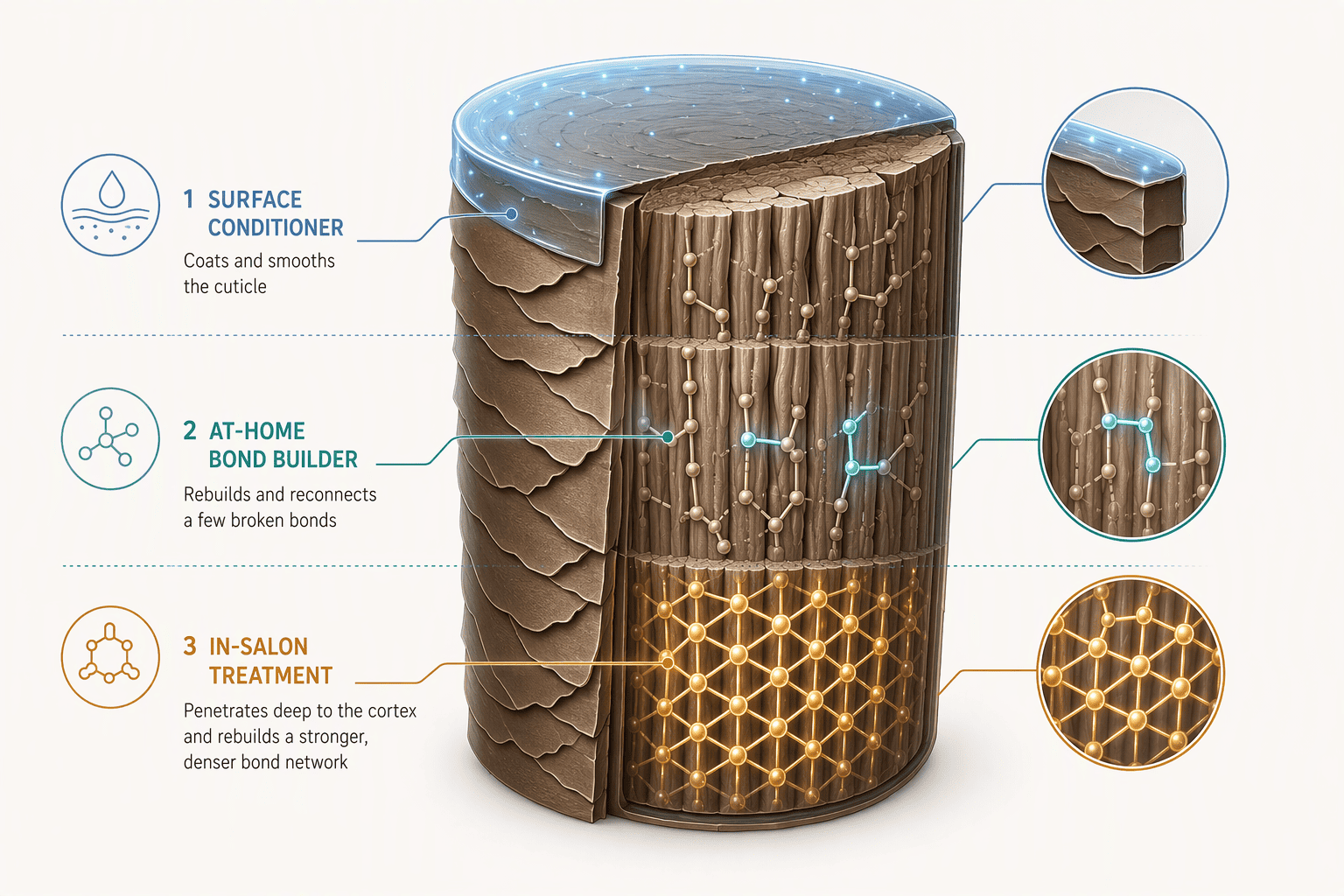
When cuticle damage reaches a critical mass, retail conditioners can only patch the surface. Professional interventions operate on a deeper chemical level. At-home bond builders attempt to reconnect broken disulfide links, but in-salon treatments use higher concentrations and controlled thermal activation to force repair inside the cortex. You get a fundamental re-knitting of the protein structure that gave your hair its tensile strength. If conditioner is polish, professional bond repair is welding.
Here's how the two technologies compare under the hood:
|
Dimension |
At-Home Conditioners & Masks |
Professional In-Salon Bond Repair (K18/Olaplex) |
|---|---|---|
|
Primary Mechanism |
Deposits fatty alcohols and oils to smooth cuticles and reduce surface friction. |
Patented peptides or bismaleinates travel into the cortex to reconnect broken disulfide bonds and polypeptide chains. |
|
Depth of Penetration |
Strictly surface-level; rinses away progressively between washes. |
Molecularly targeted; penetrates the innermost structures of the hair. |
|
Duration of Effect |
Short-term cosmetic effect (1 to 3 days). |
Cumulative and lasting; repairs damage permanently, with subsequent treatments building on previous repairs. |
|
Heat Activation Requirement |
Minimal; product sits idle on the strand. |
Often critical; a hooded dryer temporarily raises the cuticle in a controlled manner, allowing the active chemistry to diffuse into the cortex before rapid cooling locks it in. |
|
Ideal Use Case |
Daily maintenance and mild dehydration. |
Reversing straw-like texture caused by bleaching, high-heat tools, or chemical color stripping. |
The takeaway? If your hair feels dry and lifeless despite conditioning, the damage has likely passed the point of cosmetic repair. A stylist can combine concentrated bonding agents with heated emollients, chemically softening the cuticle for an hour so nourishing oils can finally replace the lost cement in the cortex. This is an entirely different category of physics from what is possible in your shower.
Conclusion
The journey to soft hair isn't an upgrade in price; it’s a downgrade in interference. You’ll need to test your water for mineral hardness, clarify your strands to remove silicone buildup, diagnose your specific porosity for the right moisturizer, and rule out a thyroid imbalance. When expensive conditioners fail, they are usually just the final, clogged layer on a problem that started weeks ago in the follicle or the pipes. Start your reset by stripping everything away, and then watch how little luxury product you actually need to rehydrate undefended hair.
If you’ve corrected your water, switched to a porosity-appropriate conditioner, and perfected your application but still see no life in your hair, the issue might not be on your head at all. Your hair is a diary of your metabolic state over the last three months. The follicle itself requires a steady supply of nutrients to produce a flexible, lubricated fiber. When your body is compromised, sebum production changes at the source. Excessive blow-drying and alcohol-based products dry the shaft externally, but internal triggers starve the new growth before it even sees daylight.
The most notorious silent saboteur is thyroid dysfunction. Underactive thyroid (hypothyroidism) and underactive parathyroid (hypoparathyroidism) are identified as medical causes of dry hair. With hypothyroidism, your metabolic engine idles too low; cell turnover slows dramatically, and the scalp struggles to produce the oils that coat the cuticle. The resulting hair turns universally brittle, sparse, and completely indifferent to deep conditioning masks. If the dry hair arrives alongside unexplained fatigue or weight changes, a blood panel is a smarter purchase than a new conditioner.
Nutritional gaps in iron, zinc, or vitamin D directly impair keratin synthesis. Extreme calorie restriction can similarly shut down non-key protein functions to conserve energy, leaving hair weak and dull at the root. Medications can also shift the ratio of anagen to telogen hairs, producing a dry, miniaturized texture. No topical can supplement a systemic deficit; here, the conditioner simply isn't the tool for the job.
Frequently Asked Questions
What are the structural reasons hair feels dry and straw-like even with conditioner?
When the cuticle’s overlapping scales lift or erode from chemical and mechanical damage, the protective armor breaks down. The inner cortex then leaks moisture and absorbs humidity unpredictably, creating a rough, tangled texture. If conditioner can’t physically reach the shaft to smooth these raised scales because of buildup, the straw-like feel remains.
What common ingredients in expensive conditioners make hair feel worse?
Heavy, non-soluble silicones like dimethicone create a dense film that blocks atmospheric moisture, causing dehydration underneath the shiny coating. Additionally, an overload of hydrolyzed keratin or wheat proteins can over-stiffen the hair’s structure. Instead of flexible and moist, the hair becomes a rigid, brittle carapace that snaps easily when stretched.
How does hard water in the US contribute to conditioner ineffectiveness?
US water rich in calcium and magnesium creates an electrical bond with conditioner fatty acids, forming a soapy scum. Hard-watered hair can be dryer, coarser and duller because this metallic film repels subsequent moisture. You must dissolve these deposits with a chelating shampoo before any conditioning treatment can penetrate the hair shaft.
What is the proper technique for applying conditioner for maximum hydration?
Follow these three application steps to maximize conditioner absorption: - Avoid the scalp: Start squeezing conditioner from chin-length down to the ends. - Emulsify first: Rub the product in your hands until it appears slightly milky before applying. - Blot excess water: Gently squeeze out water so the formula isn't diluted past the point where its fatty alcohols can deposit and seal the cuticle.
How do health or hormonal factors cause dry hair that products can't fix?
An underactive thyroid dramatically slows metabolism, reducing the scalp’s natural oil secretion at the follicle. Iron and zinc deficiencies also starve the follicle of the tools needed for keratin synthesis. The resulting dry, sparse hair is manufactured deficiently from the root, making it structurally impossible for a topical conditioner to restore its life.
How do in-salon bond treatments differ from regular conditioners for reviving hair?
Retail conditioners physically coat the surface with oils, washing away in a day. In-salon treatments use chemistry to reconnect the sulfur bonds actually broken inside the hair’s protein structure. Applied with precise heat under a hooded dryer, they permanently restore the hair’s internal scaffolding, fundamentally reversing the brittle condition rather than just hiding it.

